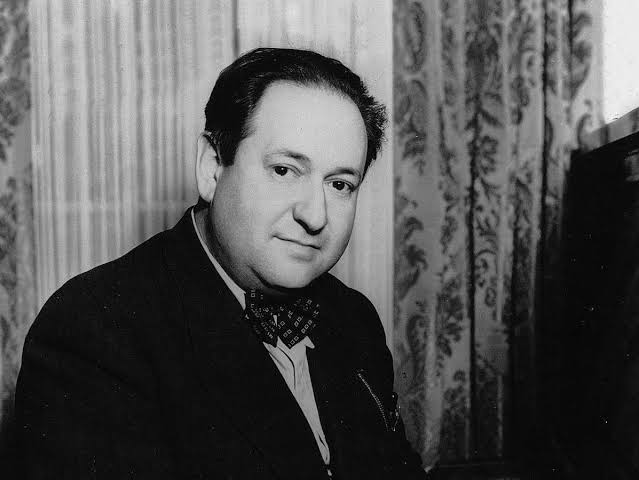
Erich Wolfgang Korngold is one of the most celebrated late romantic composers in the 20th century. A child prodigy whose brilliance was celebrated by Mahler and Richard Strauss, Korngold wrote his first opera, Die tote Stadt at the age of 23. Korngold was committed to late romantic harmony, he was unmoved by the new styles emerging from WWI, neoclassical writings in France or even the second Viennese School in his hometown of Vienna. When the International Society of Contemporary Music hosted its first festival in Salzburg, Austria in 1923, featuring works by composers from all corners of Europe, Korngold along with Wilhelm Grosz protested and held the anti-modernist Festival of Austrian Contemporary Music which featured Austrian compositions rooted in the late romantic style. As Europe was reeling from World War I, new and experimental arts and music was dominating the stages. No one was interested in recreating the excesses of late romantic music, Korngold found himself isolated from the changing styles. After a failed opera, Das Wunder der Heliane, which was overshadowed by Ernst Krenek Johnny Spielt Auf, Korngold accepted the offer from Warner Brothers to move to Hollywood and work on a score for the movie, A Midsummer’s Night Dream. Korngold’s style in Europe may have been dated, but his music became the soundtrack to many of the memorable movies in the 1930s. Korngold quickly became the sound of the Hollywood epic.
During the 1930s, Korngold split his time between Hollywood and Vienna. In Vienna he composed operas and other symphonic works, then in Hollywood he would compose scores for Warner Brothers and other studios. Starting in 1932, Korngold began writing the opera, Die Kathrin, a love story between a French soldier and a Swiss servant girl during World War I. While writing this opera, the Nazi’s gained control of Germany and Korngold lost his publisher, Schott, who was ordered not to publish works by Jewish composers. Korngold found a new publisher, Josef Weinberger and set a premiere for Die Kathrin in Vienna in 1938.[1]
During rehearsal of the opera, Korngold was ordered back to Hollywood to write the score for The Adventures of Robin Hood, starring Erroll Flynn. Korngold planned to return to Vienna before the premiere in Autumn 1938. Soon after Korngold left, Hitler annexed Austria. Die Kathrin was cancelled, and Nazis seized Korngold’s property, with orders to destroy or sell Korngold’s possessions. Josef Weinberger publishing house was disgusted at this attempt to destroy Korngold’s musical output and organized a heist during the dead of night to save Korngold’s scores.[2] The publisher succeeded in the theft, Korngold’s music was saved from this attempt at cultural destruction.
Die Kathrin ended up premiering in Stockholm in 1939. The reviews of the opera were brutal and colored by anti-semitism. With World War II breaking out that same year, Die Kathrin was shelved until 1950 when it finally received its Vienna premiere. Postwar Vienna was not a hospitable climate for a late romantic work. This opera was out of place, and out of time. The romantic period was officially dead and the the Vienna of Korngold’s youth was no longer.
Korngold had an interesting relationship with the saxophone. His first use of the instrument appears in his orchestral suite, Baby Serenade, written in 1928-1929. This piece was written after the birth of his second son. This is one of his jazziest scores, it is quite playful. The saxophone in unison with the strings provides a warmth and beauty that isn’t quite heard in other works with the saxophone during this period.
Korngold continues with the trio of saxophones in Die Kathrin. In Act II which take place in a jazz club, the jazz band is placed directly on stage for the audience to see. The following two excerpts take place in the jazz club.
The jazz in this recording is adjacent to the style popular in Zeitopern’s like Johnny Spielt auf or the Three Penny Opera. It features a stiff fox-trot, and some Gershwin-like harmonies in the lyrical section. But it’s exactly what you would expected from a late romantic writer. The saxophone was a instrument to showcase that gave the audience a taste of modernity, allowing Korngold could write in a popular music style. But that wasn’t enough to save the opera. The opera was largely forgotten. In 1998, the opera receives its first recording, the BBC Concert orchestra recorded the excerpts above. That is the only recording of the full opera. Despite the beauty, the uniqueness, this opera remains underperformed.
A look into Korngold’s writing for the saxophone in movies turns up many examples. Here in 1938 score to the film The Adventures of Robin Hood, the saxophone is used during the Maid Marian theme, starting at 4:15 in the video below, the tiny saxophone solo is heard at 6:00 minute mark. Korngold uses a duo of alto and tenor saxophone. They are mainly used in unison with the strings with brief solos.
Here is the scene with the music above. By blending the timbres, the saxophone provides a rich sorority that doesn’t sound out of place in 12th century England.
By my count, Korngold orchestrates for saxophone in 5 movies, all with an alto and tenor saxophone combination. The scores are as follows:
1935- Captain Blood-alto saxophone, tenor saxophone
1937: Prince and the Pauper-alto saxophone, tenor saxophone
1938: The Adventures of Robin Hood-alto saxophone, tenor saxophone
1939: Juarez– 2 alto saxophone, tenor saxophone
1940: Sea Hawk– 2 alto saxophone, tenor saxophone
This list is from the commercially available scores. I have yet to watch all of Korngold’s movies he scored so there might be more examples. Before I started researching opera, I would have never placed Korngold as a composer who wrote for the saxophone. While his time in Hollywood influences his scoring and interest in new instruments, his writing for the saxophone is rooted in Vienna.
[1] Carroll, Brendan G. Liner notes. Die Kathrin. Perf. BBC Concert Orchestra & BBC Singers. Cond. Martyn Brabbins. CPO (999 602-2), 1998. CD.pg. 21
[2] ibid, pg. 22
 the Operatic Saxophone
Leave a comment