All of the entries in my database have one thing in common, they all received a premiere, if not on an opera stage, then as an orchestral work. This opera defies that simple distinction, it never premiered on the stage. Despite that absence, Kommisar Rondart by Edmund von Borck is essential to saxophone history, as it inspired the first saxophone concerto. Lets look into the story of this opera.
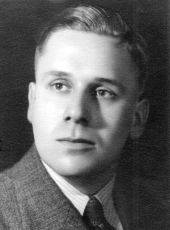
Edmund von Borck (1906-1944) was a German composer and conductor, studying at the Berliner Musikhochschule, and then becoming the assistant conductor at the Frankfurt Opera in 1931.[1] While at Frankfurt, Borck conducted the Frankfurt premiere of Aufstieg und Fall der Stadt Mahagonny by Kurt Weill. This opera, along with Ernst Krenek’s Jonny spielt auf inspired Borck along with his friend Walter Bass, to collaborate on their own jazz inspired opera, Kommisar Rondart, completed in 1931.
The political environment in Germany was changing rapidly, as Nazis were taking over cultural institutions. Borck and Bass reached out to Gustav Brecher, the conductor of the Leipzig Opera to see if he was interested in Kommisar Rondart. Brecher was instrumental in bringing new works to the stage, premiering both Jonny spielt auf and Aufstieg und Fall der Stadt Mahagonny, both of which inspired Nazi riots, which I wrote about here. Brecher showed interest in Kommisar Rondart, but since Walter Bass—the librettist—was Jewish, Brecher could not perform the work as the Nazis had already banned works by Jewish writers.[2] This opera, before it even had a chance to premiere, was officially non grata in Germany.
Borck assembled the music from the opera into a suite in 1931, which was premiered by the Berlin Philharmonic on November 28, 1931.[3] Sigurd Rascher lived in Berlin that time and would perform with the Berlin Philharmonic on the rare occasion of a saxophone was included in the score. Rascher performed in the premiere the suite and he liked the saxophone writing so much, he asked Borck to write a concerto for him. A year later, Borck invited Rascher over to play Konzert für Alt Saxophon und Orchester, op. 6 at his studio. Rascher premiered Konzert für Alt Saxophon in Hanover on October 3rd, 1932 at the Allgemeines Deutsches Tonkunstler Fest.[4] Borck’s composition of the opera, which then led to this suite, then eventually to Rascher is why we have this saxophone concerto. Without the opera, the concerto would not exist. If you are unfamiliar with the work, there are a handful of recordings, but I will link to this one, by Wildy Zumwalt, who wrote the dissertation on Borck and without his research, I would have never encountered this opera. Here is the first movement.
After writing the opera, Borck wrote another suite for orchestra that includes the saxophone, which is rarely performed. I found a recording of Fünf Orchesterstücke op. 8, located on this YouTube channel of rare recordings. I can’t link directly to the work, but if you click on the link above and search Borck, you can find the recording of Fünf Orchesterstücke taken from a radio broadcast by Radiophilharmonisch Orkest Hilversum, directed by Otto Ketting. There is no date when this broadcast took place. This work fits into the expressionist compositions of his contemporaries, Hindemith comes to mind. The saxophone has several exposed solos, angular and agressive. Borck’s writing in this suite is far removed lyrical and danceable numbers in Krenek and Weill operas.
In 1933, Borck conducted Fünf Orchesterstücke at the International Society for Contemporary Music in Amsterdam. This work was one of the standouts of that year, and received great reviews.[5] So why are there no contemporary recordings or performances of this work? That will require me to dive into the politics of Germany and the legacy of Borck, and how his next opera, Napoleon sealed his fate, the post will be coming soon, so check back for more…
Edit: I updated the entry, I had originally thought the Fünf Orchesterstücke came from Komissar Rondart, but the suite of music from the opera was a different work. That suite, along with the opera are destroyed. The only music we have from this period of Borck’s is the Konzert für Alt Saxophon and Fünf Orchesterstücke.
[1] Zumwalt, W. L. (2003). Edmund von borck: A study of his life and music with an emphasis on his works for the saxophone (Order No. 3109540). Available from ProQuest Dissertations & Theses Global. (305325204). Retrieved from https://login.proxy.lib.duke.edu/login?url=https://www-proquest-com.proxy.lib.duke.edu/dissertations-theses/edmund-von-borck-study-his-life-music-with/docview/305325204/se-2 Accessed 3/1/2024. pg. 28
[2] ibid, pg. 29
[3] Peter Muck, Einhundert Jahre Berliner Philharmonisches Orchester, vol. 2, Hans
Schneider: Tutzing, 1982, 247.
[4] Sigurd Rascher, “Letter to the Editor,” The Saxophone Symposium, The Quarterly
Journal of the North American Saxophone Alliance, Spring 1984, 21.
[5] Zumwalt, W. L. (2003). Edmund von borck: A study of his life and music with an emphasis on his works for the saxophone (Order No. 3109540). Available from ProQuest Dissertations & Theses Global. (305325204). Retrieved from https://login.proxy.lib.duke.edu/login?url=https://www-proquest-com.proxy.lib.duke.edu/dissertations-theses/edmund-von-borck-study-his-life-music-with/docview/305325204/se-2. Accessed 3/1/2024. pg. 49
 the Operatic Saxophone
Leave a comment